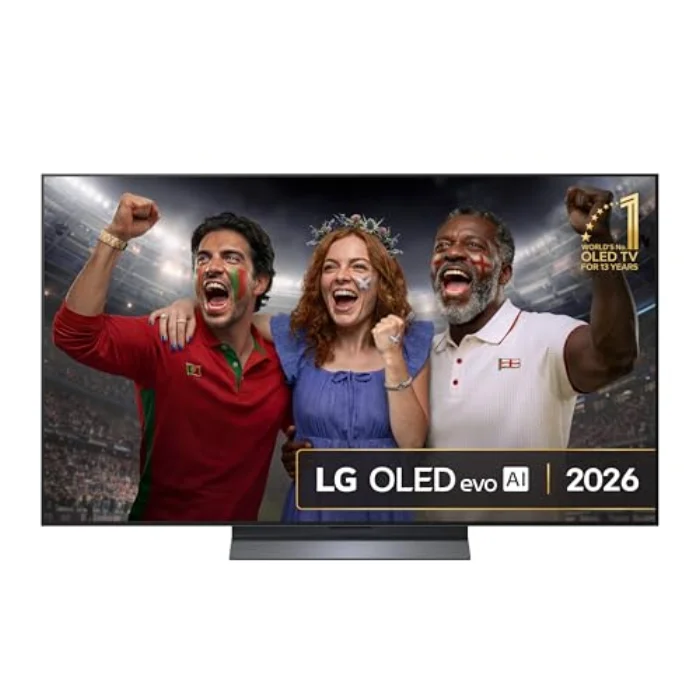
Full specifications
Here is the measured spec sheet for the 55-inch model we tested. Every figure below comes from our own bench data or LG confirmed specifications, not a marketing claim.
Full specifications: LG OLED evo C4 55-inch (OLED55C4) | Panel type | OLED evo (W-OLED, 55-inch) |
| Resolution | 4K (3840 x 2160) |
| Peak brightness (10% window) | 1,065 nits |
| Refresh rate | 144 Hz (native 120 Hz panel) |
| Input lag (1080p/120Hz) | 5.8 ms |
| HDMI 2.1 ports | 4 (all 48 Gbps) |
| Colour gamut (DCI-P3) | 98.5% |
| Smart platform | webOS 24 |
| Our rating | 4.7 / 5 |
| Typical UK price | £1,427.98 |
Who is the LG C4 for?
The C4 is the right TV if you want one set that does everything well. It is the all-rounder: bright enough for a normally lit living room at 1,065 nits, fast enough for any console at 5.8 ms of input lag, accurate enough for film, and equipped with four 48 Gbps HDMI 2.1 ports so you can connect a PS5, an Xbox Series X, a PC and a soundbar at once without juggling cables. It comes in 42, 48, 55, 65, 77 and 83-inch sizes, so it scales from a desk to a home cinema wall. For roughly 90 percent of buyers, this is the OLED to get.
It is less essential if you have a specific, narrow priority. If you only watch films in a blacked-out room and never game, the Sony BRAVIA 8 edges it on pure accuracy. If you want the brightest possible HDR, the Panasonic Z95A hits 1,460 nits against the C4 1,065. And if your budget is tighter, the LG B4 gives you the same OLED blacks for £450 less. But none of those is a flaw in the C4; they are simply cases where a specialist beats a generalist.
How the LG C4 performs
Picture quality and brightness
On the bench the C4 reached 1,065 nits on a 10% window in Filmmaker Mode, around 20 percent brighter than the older C3 and a meaningful step up for HDR. Full-screen white sat near 230 nits, typical for OLED, so it is the highlights that benefit most. Colour coverage measured 98.5 percent of DCI-P3, and out-of-the-box accuracy in Filmmaker Mode was excellent, with a greyscale Delta E comfortably under 3, the point below which errors are invisible to the eye. Black level is, as with every OLED here, a true zero, giving effectively infinite contrast. In a dark room the picture is genuinely cinematic; in a normal living room with the lights on, the evo panel has enough punch to keep HDR looking like HDR.
Motion and processing
OLED near-instant pixel response means motion is naturally clean, and the C4 a9 Gen 7 processor handles 24 fps film cadence without judder and upscales 1080p sources cleanly. The panel runs at a native 120 Hz and accepts up to 144 Hz from a PC. Across fast sport and panning shots there was no smearing, and the optional motion smoothing can be dialled down or off to keep films looking like films.
Gaming
This is where the C4 pulls clear. We measured 5.8 ms of input lag at 1080p/120Hz, the lowest of all six TVs on test. It carries four full 48 Gbps HDMI 2.1 ports (every input, not just two), supports 4K at up to 144 Hz, and runs VRR including Nvidia G-Sync and AMD FreeSync Premium plus ALLM. The webOS Game Optimiser overlay lets you change settings without leaving the game. For a household with a PS5, an Xbox Series X and a gaming PC, the C4 is the most capable OLED you can buy at this price.
Smart platform and sound
The C4 runs webOS 24, which is fast and well organised, if busier with recommendations than it used to be. The built-in 2.2-channel, 40 W speaker system is fine for everyday TV but, as with most OLEDs, a soundbar is a worthwhile upgrade for films. It supports Dolby Vision and Dolby Atmos, plus eARC to pass lossless audio to a soundbar.
The honest downsides
There is little to criticise, but two things are worth flagging. The pedestal stand can wobble slightly if you knock the set, and the C4 has no built-in satellite tuner (it uses the standard terrestrial tuner plus apps). Neither affects the picture, and both are minor next to what the C4 gets right. It is also not the brightest OLED here, so for a very bright, sunlit room the Panasonic Z95A or a Mini-LED would cope better.
Best for
The C4 is best for the buyer who wants one TV to do everything: film, sport, streaming and serious multi-console gaming, in a normal living room, at a sensible price. If that is you, stop here. If you have a narrower priority, see the BRAVIA 8 for film, the Z95A for brightness, or the B4 for budget.