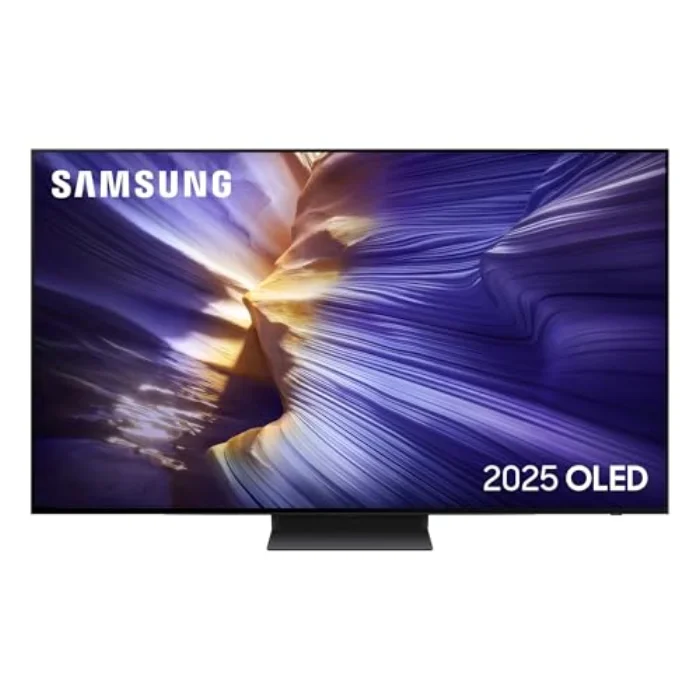
Full specifications
Below is the measured spec sheet for the 55-inch QE55S90D we tested. Figures come from our own bench data or Samsung confirmed specifications.
Full specifications: Samsung S90D OLED 55-inch (QE55S90D) | Panel type | QD-OLED (55-inch) |
| Resolution | 4K (3840 x 2160) |
| Peak brightness (10% window) | 1,015 nits |
| Refresh rate | 144 Hz |
| Input lag (1080p/120Hz) | 9.2 ms |
| HDMI 2.1 ports | 4 (all 48 Gbps) |
| Colour gamut (DCI-P3) | 99.2% |
| Smart platform | Tizen (2024) |
| Our rating | 4.6 / 5 |
| Typical UK price | £998.98 |
Who is the Samsung S90D for?
The S90D is the right TV if colour is what excites you and you watch a lot of HDR. Its QD-OLED panel covered 99.2 percent of DCI-P3, the widest of our six, and it holds those saturated colours at high brightness in a way W-OLED cannot quite match. It is also a strong choice for a brighter room: at 1,015 nits with a good anti-reflection coating, it handles daylight better than most OLEDs. With four full 48 Gbps HDMI 2.1 ports and 144 Hz it is a capable gaming TV too.
It is less ideal if you rely on Dolby Vision. Samsung backs the rival HDR10+ format and does not support Dolby Vision on any of its TVs, so on the many films and shows mastered in Dolby Vision the S90D falls back to standard HDR10. If that matters to you, the LG C4 or Sony BRAVIA 8 are the answer. For everyone else, the S90D colour advantage is the headline.
How the Samsung S90D performs
Picture quality and colour
QD-OLED is the S90D party trick. We measured 1,015 nits on a 10% window and, crucially, 99.2 percent DCI-P3 colour coverage, the highest here. The practical effect is that vivid scenes, a neon city, a sunlit garden, a red sports kit, look noticeably richer and more luminous than on a W-OLED at the same brightness. Out-of-the-box accuracy in Filmmaker Mode was very good, with a Delta E under 3. Blacks are the usual perfect OLED zero, although in a very bright room the QD-OLED panel can show a very faint magenta tint to deep shadow that W-OLED avoids; in normal viewing you will not notice it.
Motion and processing
The NQ4 AI Gen2 processor handles motion cleanly, with no judder on 24 fps film and tidy upscaling of HD sources. The panel runs at 144 Hz, so high-frame-rate PC gaming is on the table, and OLED instant response keeps fast motion sharp.
Gaming
The S90D is an excellent gaming TV. We measured 9.2 ms of input lag at 1080p/120Hz, a touch behind the LG C4 5.8 ms but still very low. It has four full 48 Gbps HDMI 2.1 ports, 144 Hz, VRR with FreeSync Premium Pro and a Gaming Hub that brings cloud gaming services without a console. For a colour-first gamer it is a fine pick; for the lowest latency the C4 still leads.
Smart platform and sound
Tizen is fast and feature-rich but does push advertising on the home screen, which some owners dislike. The Object Tracking Sound speaker system is decent for the class, moving audio to follow on-screen action, but a soundbar is still the upgrade for films. It supports HDR10+ Adaptive and Dolby Atmos.
The honest downsides
The S90D has two real weaknesses. The first is the absence of Dolby Vision, which is a genuine miss given how much content uses it. The second is the Tizen interface, which is responsive but cluttered with ads. Neither dents the core picture, which is superb, but both are worth knowing before you buy.
Best for
The S90D is best for the buyer who prizes vivid, saturated colour, watches a lot of HDR10+ content and wants flagship picture quality for less than the LG and Sony. If Dolby Vision is on your must-have list, look at the LG C4 instead, and see how the two compare in our C4 vs S90D showdown.