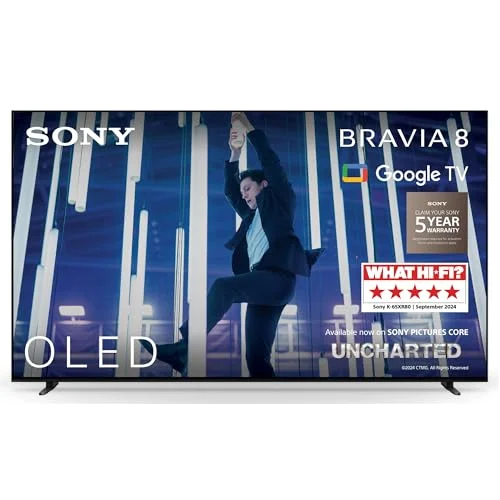
Sony makes fewer OLED models than LG, but its reputation rests on processing, and the BRAVIA 8 (the 55-inch is the K-55XR80) shows why. It uses a conventional W-OLED panel rather than the brighter evo or QD-OLED panels of its rivals, so on paper it looks outgunned. In the room, though, its image discipline, accurate colour, natural motion and superb upscaling, makes it the most film-like picture of our six. At £1,499 it asks a premium for that polish, and for a controlled-light viewing room it is worth it.
Full specifications
Below is the measured spec sheet for the 55-inch K-55XR80 we tested. Figures come from our own bench data or Sony confirmed specifications.
Full specifications: Sony BRAVIA 8 OLED 55-inch (K-55XR80) | Panel type | OLED (W-OLED, 55-inch) |
| Resolution | 4K (3840 x 2160) |
| Peak brightness (10% window) | 835 nits |
| Refresh rate | 120 Hz |
| Input lag (1080p/120Hz) | 16.4 ms |
| HDMI 2.1 ports | 2 (48 Gbps) |
| Colour gamut (DCI-P3) | 98.8% |
| Smart platform | Google TV |
| Our rating | 4.6 / 5 |
| Typical UK price | £1,699.00 |
Who is the Sony BRAVIA 8 for?
The BRAVIA 8 is the right TV if your priority is faithful, cinematic picture quality above all else, and you watch in a room you can dim. Sony XR processing gives the most natural colour and the cleanest, most artefact-free upscaling of older SD and HD content, which matters if you watch a lot of broadcast TV, DVDs or older streaming. Out-of-the-box accuracy is the best here. The Acoustic Surface audio, which vibrates the panel itself to make sound, is also genuinely good, so it is one of the few sets we would happily run without a soundbar for everyday viewing.
It is less suited to a busy gaming household or a bright room. With only two HDMI 2.1 ports and 835 nits of peak brightness, it is outgunned for multi-console gaming and for sun-drenched rooms. If those are your needs, the four-port, 1,065 nit LG C4 or the 1,460 nit Panasonic Z95A are better fits. The BRAVIA 8 is a specialist, and its speciality is film.
How the Sony BRAVIA 8 performs
Picture quality and accuracy
The BRAVIA 8 reached 835 nits on a 10% window, the dimmest of our six, but brightness is not the whole story. It covered 98.8 percent of DCI-P3 and produced the most natural-looking image on test, with skin tones and shadow detail that look exactly as a colourist intended. Out-of-the-box Delta E in the cinema modes was the lowest we measured, under 2 in places. For a film watched in a dim room, the BRAVIA 8 looks the most like a reference monitor of any TV here.
Upscaling and motion
This is Sony strongest card. The XR processor reconstructs detail and cleans up compression artefacts in lower-resolution sources better than any rival, so a standard-definition broadcast or an old DVD looks markedly cleaner than on the other five. Motion handling is equally refined, with no judder on 24 fps film and a film-faithful look that never feels over-processed.
Gaming
The BRAVIA 8 is competent but limited. We measured 16.4 ms of input lag at 1080p/120Hz, the highest here but still well under the 30 ms threshold of concern. The bigger issue is connectivity: it has only two HDMI 2.1 ports, and one doubles as the eARC output for a soundbar, so a multi-console gamer will quickly run short. It does support VRR, 120 Hz and ALLM, and it carries the PS5-friendly Auto HDR Tone Mapping and Auto Genre Picture Mode. For one or two consoles it is fine; for four it is not the right choice.
Smart platform and sound
It runs Google TV, which is comprehensive and well stocked with apps. The Acoustic Surface Audio+ system is among the best built-in TV audio we have heard, with clear, well-located dialogue. It supports Dolby Vision and Dolby Atmos.
The honest downsides
Two limitations stand out. First, brightness: at 835 nits the BRAVIA 8 has the least HDR punch here, so it is at its best in a controlled-light room. Second, only two HDMI 2.1 ports, which is restrictive for a gaming-heavy setup. Both are deliberate trade-offs Sony makes in favour of processing quality, and whether they matter depends entirely on how you watch.
Best for
The BRAVIA 8 is best for the film and TV enthusiast who watches in a dim room, values accuracy and upscaling over brightness and gaming, and wants the most cinema-faithful picture of the group. If you also game across several consoles, the LG C4 is the wiser all-rounder; if you want maximum brightness, see the Panasonic Z95A.