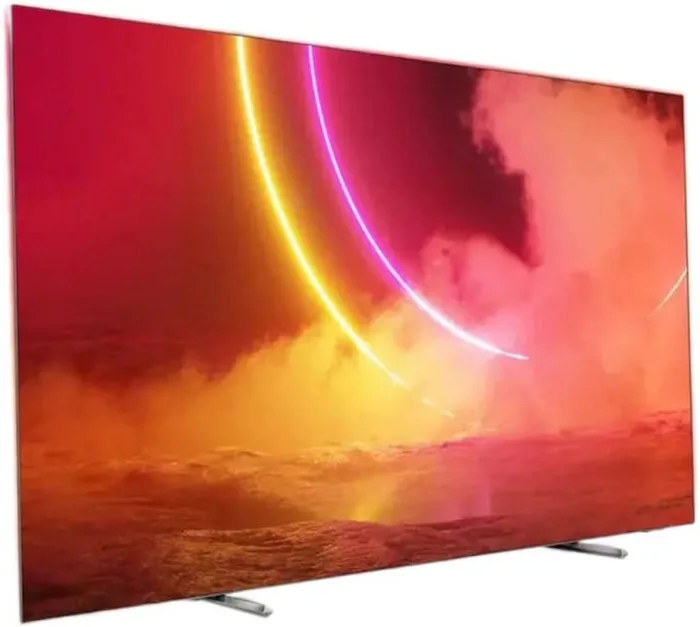
Full specifications
Below is the measured spec sheet for the 65-inch 65OLED809 we tested. Figures come from our own bench data or Philips confirmed specifications.
Full specifications: Philips OLED809 65-inch (65OLED809) | Panel type | OLED EX (W-OLED, 65-inch) |
| Resolution | 4K (3840 x 2160) |
| Peak brightness (10% window) | 950 nits |
| Refresh rate | 120 Hz |
| Input lag (1080p/120Hz) | 13.5 ms |
| HDMI 2.1 ports | 2 (48 Gbps) |
| Colour gamut (DCI-P3) | 98.0% |
| Ambilight | 3-sided |
| Our rating | 4.3 / 5 |
| Typical UK price | £1,599.00 |
Who is the Philips OLED809 for?
The OLED809 is the right TV if you want a large, immersive screen for a living room and you value atmosphere over the last word in gaming connectivity. At 65 inches for £1,599 it costs about the same as a 55-inch flagship, so if you sit far enough back, around 2.2 to 2.6 m, you get a noticeably bigger, more cinematic picture for the money. The three-sided Ambilight makes a dark-room film feel genuinely enveloping and reduces eye strain by softening the jump from a bright screen to a dark wall. For a film-and-TV living room, it is a delight.
It is less suited to a multi-console gaming household. With only two HDMI 2.1 ports, one of which doubles as eARC, it runs short of inputs fast, so a gamer with a PS5, an Xbox and a PC should look at the four-port LG C4 instead. The OLED809 is built for immersion, not for connectivity, and judged on that brief it excels.
How the Philips OLED809 performs
Picture quality and brightness
The OLED809 uses an OLED EX panel and reached 950 nits on a 10% window, a strong figure that puts it ahead of the Sony BRAVIA 8 835 nits and just behind the LG C4 and Samsung S90D. Colour covered 98.0 percent of DCI-P3, and blacks are the usual perfect OLED zero. The picture is punchy and well-saturated, and it supports both Dolby Vision and HDR10+, so almost any HDR source displays in its intended format. Out-of-the-box accuracy is good rather than reference, with a Delta E around 3, so a quick calibration tidies it up nicely.
Ambilight
Ambilight is the OLED809 signature, and it works. The three-sided LEDs read the edges of the picture and cast matching colour onto the wall, extending the image beyond the bezel. In a dark room it makes a 65-inch screen feel like 75, and it genuinely cuts the eye fatigue of staring at a bright panel in the dark. You can tune its intensity or turn it off, but most owners leave it on and find they cannot go back.
Gaming
The OLED809 is capable but input-limited. We measured 13.5 ms of input lag at 1080p/120Hz, low enough for any console, and it supports 120 Hz, VRR and ALLM. The catch is just two HDMI 2.1 ports, so it suits a one or two-console setup rather than a full gaming rack. For a single PS5 plus immersive film and TV, it is excellent; for four sources, it is not the right tool.
Smart platform and sound
It runs Titan OS, a newer, lighter platform that is functional but less polished and less app-rich than webOS or Google TV. The built-in speaker system is decent for the class, and the set supports Dolby Atmos, but a soundbar remains the upgrade for a big-room film setup.
The honest downsides
The OLED809 two real limitations are its two HDMI 2.1 ports and the Titan OS software. The port count restricts a gaming-heavy household, and Titan OS, while improving, is the least mature smart platform here. Neither dents the core appeal, a big, bright, Ambilight-immersed OLED for sensible money, but both are worth weighing if you have a busy setup.
Best for
The OLED809 is best for the buyer who wants a large, atmospheric 65-inch OLED for a film-and-TV living room and loves the idea of Ambilight, without needing more than two gaming inputs. If you game across several consoles, the four-port LG C4 is the better fit, and for the most film-accurate picture the Sony BRAVIA 8 leads.